
Unconfirmed Parent Transactions and Why They Block Yours
A transaction that spends an output still waiting in the mempool is a child of an unconfirmed parent, and acceleration tools will not touch it: a transaction that contains unconfirmed inputs cannot be accelerated at all, so the submission is refused rather than queued. The repair takes one extra step, not extra hardware — confirm the parent, and the child becomes ordinary work again. On the free tier that step costs nothing whenever the parent is at most 0.5 KB in size and carries a fee rate of at least 0.0001 BTC/KB.[1]
Key takeaways
- A transaction with any unconfirmed input is rejected for acceleration, and double-spend transactions are not supported at all — the parent has to be pushed first.
- Free submissions must be 0.5 KB or smaller and pay a fee rate of at least 0.0001 BTC/KB; the free quota refreshes hourly and requests are processed in submission order.
- At exactly the free-tier floor, a 0.5 KB transaction carries 0.00005 BTC of fee, about $4.23 at a BTC price of $84,692.
- The paid route accepts BTC, BCH or LTC, debits the account balance directly, and cannot be cancelled or refunded once submitted.
Why the numbers move
Two figures decide whether a stuck transaction moves at all: the fee rate your wallet attached, measured in BTC per kilobyte of transaction weight, and how much unconfirmed weight is competing for the same block space. On a quiet mempool even a modest rate clears within an hour. During a burst, the same transaction can sit untouched for days while the rate you would need to jump the queue multiplies.
That volatility is exactly why chained transactions hurt so much. If your withdrawal spends an output that has not confirmed yet, you are not waiting on one confirmation, you are waiting on two in sequence. The child cannot be prioritised on its own, because no miner can include it before its parent exists in a block. Submit it anyway and the tool simply rejects the request.
The other half of the picture is your own chain of custody. A pool that settles mining income on a fixed cadence gives you a predictable stream to spend from, which means you rarely need to move coins in a hurry and start a chain of dependent transactions in the first place. ViaBTC's listing shows PPS+ paying per share against current difficulty every hour, with PPLNS distributing after a block collects six confirmations, measured over the last five difficulty rounds.[2]
What changes your payout
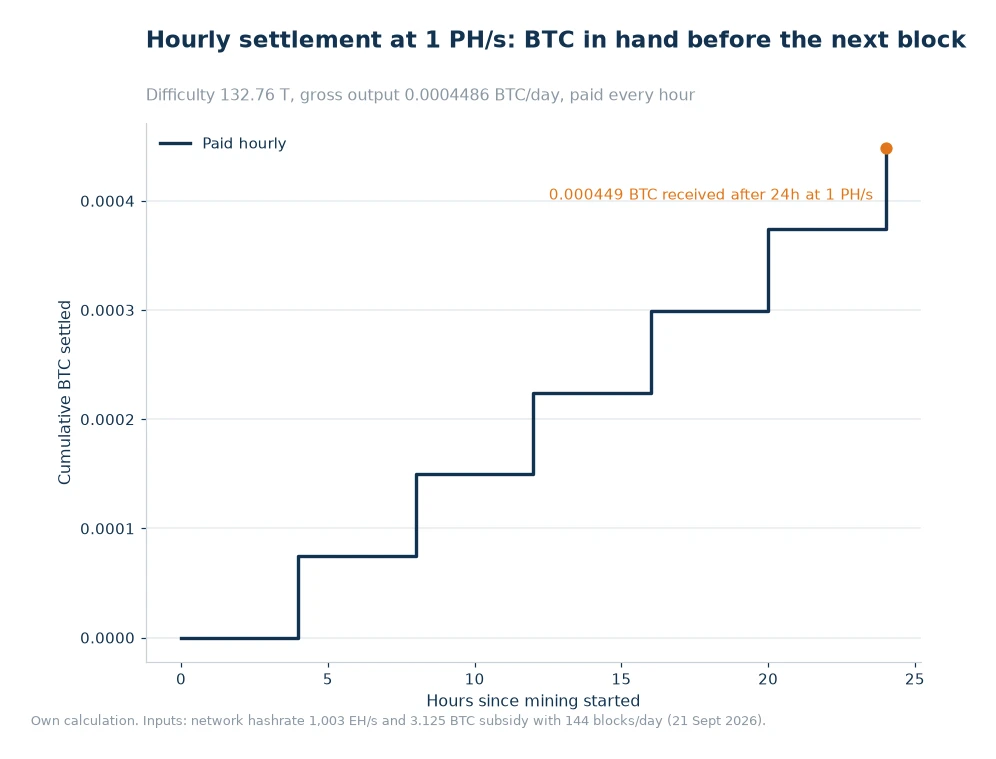
Acceleration requests are paid from the same account that mining income lands in, so the size of that balance matters as much as the transaction you are trying to rescue. A small rig does not need a large float. At 1 PH/s and today's network figures, output is roughly 0.0000187 BTC per hour, or about $1.58, and 0.000449 BTC a day at a BTC price of $84,692. Two to three hours of that covers the arithmetic below. If you are sizing hardware against that figure, check it with a profit calculator rather than a marketing spec sheet, since coin price, difficulty and fee rate all move the answer.
| Transaction | Size | Fee rate | Free submission | What happens next |
|---|---|---|---|---|
| Straight withdrawal, confirmed inputs | 0.4 KB | 0.00012 BTC/KB | Yes | Queued for the next block the pool mines |
| Same withdrawal, thinner fee | 0.4 KB | 0.00008 BTC/KB | No — rate below floor | Top up the fee or use the paid route |
| Consolidation of many small outputs | 0.9 KB | 0.0002 BTC/KB | No — over the 0.5 KB cap | Paid route in BTC, BCH or LTC |
| Child spending an unconfirmed output | 0.3 KB | 0.0003 BTC/KB | Blocked | Accelerate the parent first |
| Replacement of the same coins | any | any | Not supported | Double spends are outside scope |
The table is the reason the phrase "why is my transaction stuck" has two completely different answers. A thin fee is a pricing problem, solved with money. An unconfirmed parent is a sequencing problem, and no amount of money fixes it inside the same transaction — the parent has to land first.
Worked example
Suppose a 0.4 KB withdrawal went out at 0.00008 BTC/KB and has not confirmed. The rate is 20% under the 0.0001 BTC/KB floor, so a free submission is not available. To reach the floor the transaction needs 0.4 × 0.0001 = 0.00004 BTC of fee, which is about $3.39 at $84,692 per BTC, and it is worth roughly 2.1 hours of output from a single 1 PH/s miner.
Now suppose the stuck transaction is the child. The output it spends is still unconfirmed, so the submission is refused and the fee is irrelevant. The recoverable move is to submit the parent instead: measure its size against the 0.5 KB cap, confirm the fee rate clears 0.0001 BTC/KB, and let the confirmation cascade do the rest. Once the parent is in a block, the child is an ordinary transaction again and any normal fee strategy applies. The one thing not to do is submit a replacement that spends the same coins twice — neither the free nor the paid path accepts double-spend transactions.
This is also why the sequence in the form matters. A submission enters the pool's own queue for the next block it mines, which means the practical bottleneck is not your willingness to pay but whether the transaction is structurally eligible when you press submit. That is why the ViaBTC TX Accelerator is a better fit for a parent-first plan than for a last-minute rescue of a chain: free slots refresh hourly and are handed out in the order requests arrive, so the earlier a valid parent is submitted, the further forward it sits.
What to check monthly
- Unconfirmed parents in your own flow. Count how often a withdrawal spends a fresh payout. If it happens more than once or twice a month, wait for one confirmation before spending and the problem disappears.
- Your typical fee rate against 0.0001 BTC/KB. Wallets often default below that floor. A transaction at 0.00008 BTC/KB looks normal and is still ineligible.
- Transaction size. Consolidations of many small outputs cross the 0.5 KB cap quickly. Batch them deliberately rather than by accident.
- Liquid balance. Hourly settlement at current difficulty returns about 0.0000187 BTC per PH/s, so the float needed to fix a stuck transaction is small — but it has to be in the account, in a supported asset.
- Alerts. A worker or withdrawal alert that fires within minutes beats discovering a chain of unconfirmed transactions a week later.
Income that arrives hourly and sits in a multi-currency wallet next to the mining dashboard also shortens the chain itself: there is no external transfer to wait on before you can spend, and zero-fee mining payouts mean the balance is not nibbled away by withdrawal costs.
Frequently asked questions
Can I mine more than one coin at the same time?
Yes. Merged mining lets a machine secure a parent chain and an auxiliary chain together, and multi-coin pools support switching between chains without moving hardware.
Do mining pools cost anything to join?
Joining is free; the pool earns from its fee on settled payouts, which appears as a percentage of the block-reward and transaction-fee components.
Can an acceleration request be cancelled or refunded?
No. Once submitted, a request cannot be cancelled and the charge is not refunded, which is the practical argument for checking size and fee rate before submitting rather than after.
Parent first, child second
The standing rule for stuck chains is to work backwards to the oldest unconfirmed transaction and treat that one as the real problem. Check its size against 0.5 KB, check its rate against 0.0001 BTC/KB, and submit the version that qualifies. Everything downstream resolves by itself once the first link confirms. Keep one confirmed payout in reserve and you will rarely need to think about any of this again.
Data and sources: ViaBTC transaction accelerator documentation[1] and the published fee schedule[2]. Network difficulty (132.76 T), network hashrate and BTC price ($84,692) were read from public chain data on 21 September 2026. Transaction sizes in the table are illustrative examples; figures are rounded and move with difficulty, mempool conditions and price.