
The Sample Round Calendar: Scheduling a Seasonal Collection Backwards
A seasonal collection should be scheduled backwards from the date the product has to be on shelf, not forwards from the day the brief is written. Working backwards forces the two things that decide the date into view: how long the sample round realistically needs, and how much of the compliance and packaging work can run in parallel. The calendar built this way is less optimistic and considerably more useful.
Key takeaways
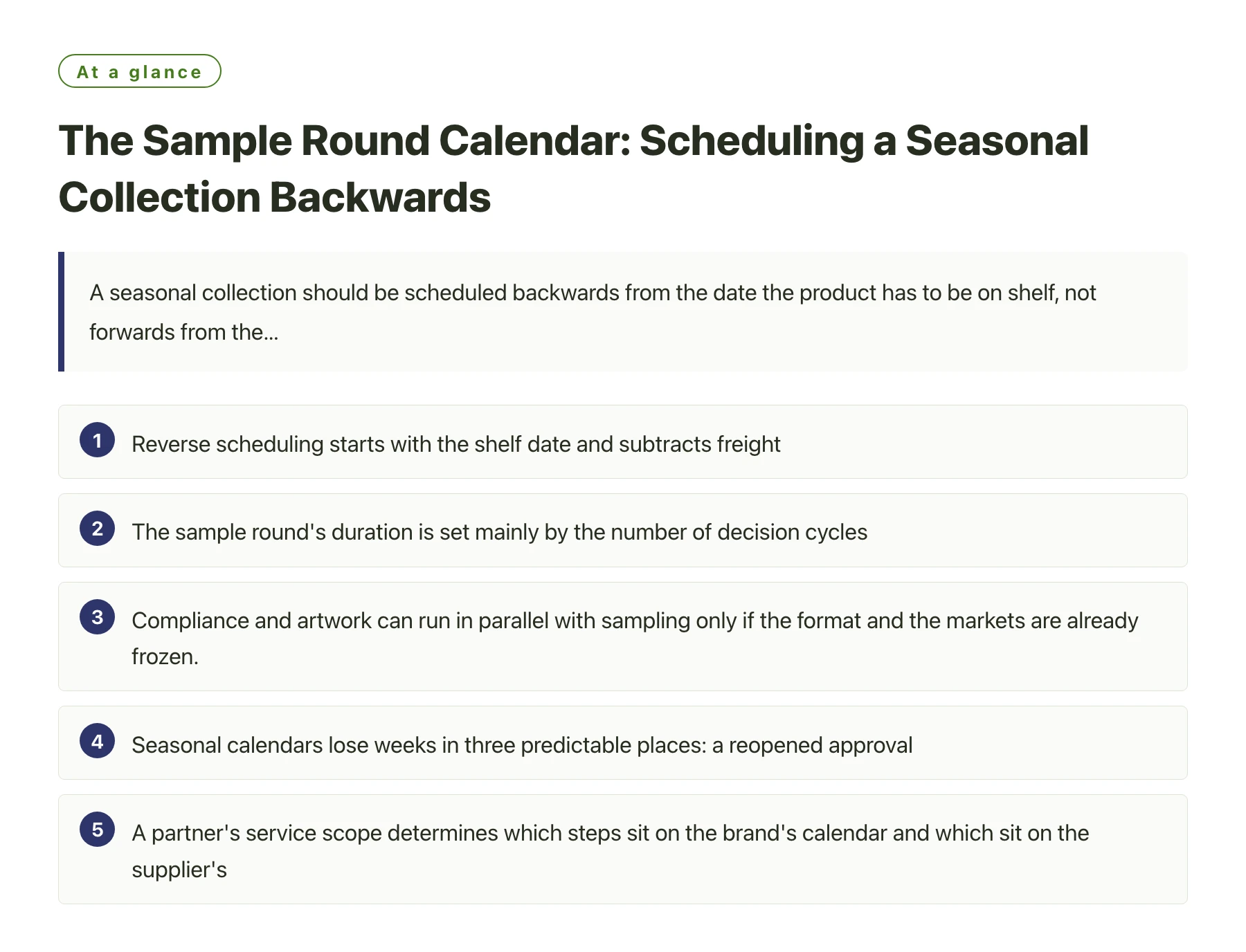
- Reverse scheduling starts with the shelf date and subtracts freight, production, packing and the approval buffer before placing the sample round.
- The sample round's duration is set mainly by the number of decision cycles, not by laboratory time.
- Compliance and artwork can run in parallel with sampling only if the format and the markets are already frozen.
- Seasonal calendars lose weeks in three predictable places: a reopened approval, a base that was never trialled, and a declaration list assembled after the formula was locked.
- A partner's service scope determines which steps sit on the brand's calendar and which sit on the supplier's, so scope has to be settled before the timeline is agreed.
Timelines in fragrance projects are usually written forwards: brief, sampling, approval, production, shipment. That order is correct and almost useless as a planning tool, because it hides how little control the later stages have over the date.
Reverse scheduling is the alternative. Write the shelf date on the right, then step left through each stage, asking what must be finished before the next one can start. The sample round stops being a vague block and becomes a set of decisions with dates attached.
This is written for a project manager running a seasonal drop who has to publish a schedule and then defend it. None of the durations below are fixed, because they depend on the product and the number of items; what is stable is the order of the work and the location of the slack.
Start from the shelf date and work backwards
The furthest step left on the calendar is not the brief; it is the point at which the item list and the target markets are frozen. Everything downstream depends on those two decisions, because they determine how many bases need trials and how many labelling conversations have to happen.
Working backwards also exposes which stages can overlap. Artwork and label copy can move while the scent is being chosen, provided the format is fixed. Compliance work can begin as soon as the draft formula is stable. What cannot overlap is the approval itself: the bulk order should not be released before a reference exists, or the comparison has no standard.
The rule of thumb is that the sample round consumes calendar in decision cycles, not in laboratory days. A round where the brand answers within a fixed window after each delivery is dramatically shorter than one where the answers arrive when the meeting can be arranged. The scope a partner works under matters here too: a project run with Xuelei OEM/ODM support can keep some stages inside the factory, while a purely development-led project keeps them with the brand.
Freeze the item list first
Until the item list is fixed, the number of application trials is unknown, and the sample round cannot be scheduled with any confidence. One scent across three carriers is three trials, and each trial has to be evaluated and approved in its own base.
Name the decision windows
Give each review a fixed number of working days to return a decision, and put those dates on the published schedule. This is the single most effective compression technique available, and it costs nothing.
The sequence in reverse, and what sets each duration
| Step (latest to earliest) | What sets its duration | What can compress it |
|---|---|---|
| On-shelf date and sell-in window | Retailer calendar, which the brand does not control | Nothing; this is the fixed end of the plan |
| Freight and customs clearance | Route, mode and documentation completeness | Complete paperwork before dispatch; this is where missing documents cost weeks |
| Packing and quality release | Number of components, decoration complexity and the release check | Fix artwork early; keep the reference available for the release comparison |
| Bulk production | Volume, scheduling slot and material availability | Confirm the formula and materials before booking the slot with a a manufacturer that supports OEM and ODM |
| Compliance and labelling sign-off | Number of target markets and the declaration list | Run it in parallel with sampling once the draft formula is stable [1] |
| Sample round and approval | Number of directions, number of bases and the speed of brand decisions | Cap the rounds; write a precise brief; trial in the real base |
| Brief, item list and markets frozen | Internal alignment rather than any external process | Decide early; this is the cheapest stage to accelerate |
Read the table from the bottom up and the plan writes itself. The essential insight is that the stages the brand controls are concentrated at the bottom, and they are also the cheapest to compress. The stages near the top depend on external parties and are expensive to rush, which is why a seasonal schedule should be protected by finishing the early stages early rather than by asking later ones to hurry.
Building the reverse calendar in seven moves
- Fix the shelf date and the sell-in dateWrite both down. The sell-in date is usually the real constraint, because the retailer needs stock before the season opens.
- Subtract freight and clearanceUse a realistic allowance for the route and the documentation, and add a buffer for customs queries on a first shipment.
- Subtract packing and releaseInclude the release check against the reference sample. If decoration is involved, its lead time belongs here rather than hidden in production.
- Subtract bulk productionThe volume and the supplier's slot availability set this block. Book it only after the formula is frozen.
- Place the compliance and labelling workDecide explicitly whether it runs in parallel with sampling or after it. Parallel is faster and requires the format and markets to be frozen first.
- Place the sample round and count its cyclesCount decision cycles rather than days, and cap the number of revision rounds before the round begins.
- Publish the decision dates, not just the milestonesMilestones tell people what will happen; decision dates tell them when they have to act.
A seasonal calendar should contain one declared buffer, and it should sit between the approved reference and the bulk order. This is the buffer that absorbs a late formula change without moving the shelf date. Calendars that spread small buffers everywhere tend to lose all of them one at a time, and the first thing to be dropped is usually the bulk comparison against the reference — which is exactly the check that catches a dosage drift before it reaches the market.
Where seasonal calendars lose weeks
The first loss is a reopened approval. A direction is approved, artwork proceeds, and a stakeholder who missed the review reopens the discussion. The fix is procedural rather than technical: one approval owner, a fixed review window and a written record of what was decided.
The second loss is an untrialled base. A scent is approved on a blotter, the finished product smells different, and a new trial cycle begins after the formula was supposedly frozen. The fix is to trial each base during the round rather than after it.
The third loss is documentation assembled at the end. Declaration lists, label wording and technical summaries all depend on decisions taken during development, and each market adds its own requirement. Trade coverage of the personal care supply chain regularly shows how much of a launch delay comes from paperwork rather than from manufacturing [2]. Regulatory reference material is public, and the market-specific topics are worth reading before a seasonal range is scheduled rather than after, since terminology alone can add a review cycle [3].
There is a technical dimension that helps here too. Understanding how aroma materials behave — which are volatile, which persist, and how a base changes perception — makes a team faster at approving because it can interpret what it smells [4]. The same knowledge reduces the number of rounds needed to reach a decision, which is the most direct way to shorten the critical path.
Finally, check how much of this work the partner takes on. A manufacturer that supports both development-led and specification-led programmes can move some stages inside its own process. Where development, filling and packing sit with one partner, such as in one-stop scent development, hand-offs disappear from the calendar altogether. Before agreeing a schedule with any of them, read its background and certifications for what the supplier publicly states about its own systems, then verify the documents during the round rather than trusting the list.
None of this removes the fixed end of the calendar. It only decides how much of the remaining time is spent waiting rather than working.
Sources
- European Commission: Cosmetic Products — Specific Topics —— EU pages covering specific cosmetics topics such as product claims, nanomaterials and animal-testing rules.
- HAPPI — Household & Personal Products Industry —— An industry magazine covering the household and personal care market, including fragrance, formulation and packaging.
- Cosmetics Europe —— The European trade association for the cosmetics and personal care industry, publishing guidance, positions and market information.
- American Chemical Society —— A scientific society publishing chemistry research and educational resources, including material on aroma and volatile compounds.
Frequently asked questions
How far in advance should a seasonal fragrance collection be planned?
Work backwards from the sell-in date rather than picking a number of months. Subtract freight and clearance, packing and release, bulk production, compliance sign-off and the sample round, and the resulting start date is the honest one. Seasonal ranges usually reveal that the sample round has to start earlier than the team assumed.
What is the biggest cause of seasonal lead time overruns?
Reopened approvals and late documentation, not laboratory speed. Both are brand-side issues and both are cheaper to fix than production delays, which is why the early stages of the reverse calendar deserve the most attention.
Can compliance work run in parallel with the sample round?
Yes, once the format and target markets are frozen. Declaration lists and label wording depend on the formula and the markets, so parallel work is possible as soon as the draft is stable. Delaying it until after approval removes flexibility for no benefit.
Where should the schedule buffer sit?
Between the approved reference and the bulk order, where it can absorb a late change without moving the shelf date. Buffers spread across every stage tend to be consumed silently, and the bulk comparison is usually the first casualty.
Does one supplier for development, filling and packing shorten the timeline?
It removes hand-offs and the waiting time between them, which is real, but it does not remove the need for brand-side decisions on time. The calendar shortens because fewer parties are waiting on each other, not because the work itself becomes faster.
We'd be glad to listen.